
Circumference of a Roll of Toilet Paper: Math, Dimensions, and Everyday Secrets
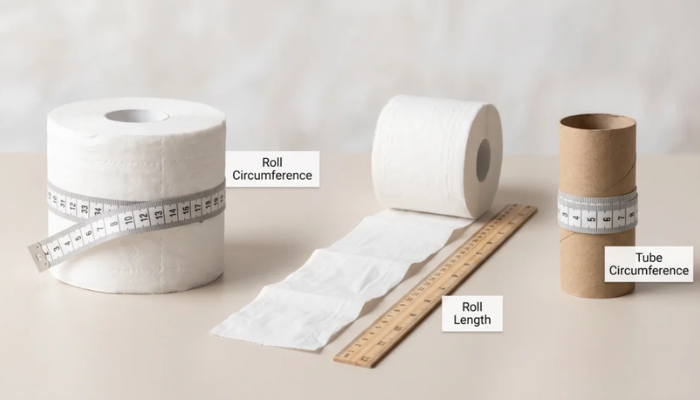
The circumference of a roll of toilet paper might sound like a niche topic reserved for trivia nights or geometry teachers, but this simple measurement plays a massive, unexpected role in everyday engineering, household organization, DIY craft planning, and supply chain logistics. Whether you are trying to build a custom bathroom storage holder, craft a intricate cardboard tube project, or calculate manufacturing material usage, understanding the physical geometry of an ordinary toilet paper roll reveals a fascinating blend of geometry and design. While most people grab a fresh roll without a second thought, taking a closer look at its outer boundary opens up a world where circular math meets practical everyday utility.
Measuring the distance around a toilet paper roll is far more than just a quick exercise with a tape measure; it is a dynamic measurement that shrinks every single time someone pulls off a few sheets. Depending on whether you are analyzing a brand-new, mega-sized roll fresh out of the plastic wrap or measuring the bare cardboard tube inside, the outer perimeter changes dramatically. In this comprehensive guide, we will unpack everything you need to know about calculating, predicting, and applying the dimensions of toilet paper rolls, bridging the gap between basic geometry and clever household hacks.
The Core Geometry Behind Measuring Paper Rolls
To calculate or measure the outer boundary of a toilet paper roll, you must first turn to basic circular geometry. The fundamental relationship connecting the distance across a circle to the distance around it hinges on the mathematical constant Pi ($\pi \approx 3.14159$). Mathematically, the formula is expressed as $C = \pi \times d$, where $C$ represents the total distance around the outer edge, and $d$ represents the total outer diameter. On a standard, unused roll with a typical diameter of 4 to 5 inches (10.1 to 12.7 centimeters), applying this formula gives an outer perimeter ranging between 12.5 and 15.7 inches (31.7 to 39.9 centimeters).
However, measuring a squishy, flexible paper object introduces real-world variables that pure textbook geometry rarely accounts for. Standard toilet paper features soft, quilted plies and loosely wound air gaps designed for absorption and comfort rather than mechanical rigidity. If you press down too hard with a rigid ruler or pull a flexible measuring tape too tightly around the soft tissue, you inadvertently compress the layers and skew the measurement. To get an accurate reading, experts and crafters alike recommend using a soft tailor’s tape measure or wrapping a strip of non-stretching string around the widest part of the roll, marking the point where the ends meet, and measuring that flattened line against a hard ruler.
Standard Sizes and the Evolution of the Roll
Not all toilet paper rolls are created equal, and their dimensions have evolved dramatically over recent decades due to changing consumer habits and commercial cost engineering. Traditionally, a standard household roll featured a uniform width of 4.5 inches and a consistent outer diameter. Today, manufacturers produce a vast array of options ranging from standard and double rolls to mega, super-mega, and commercial jumbo rolls found in public restrooms. A standard home roll usually features an outer boundary of around 12.5 inches, whereas a modern mega roll—designed to fit fewer refills into high-traffic households—can easily boast a diameter exceeding 5.5 inches, yielding a massive outer perimeter of over 17.2 inches.
| Roll Type | Typical Outer Diameter | Average Outer Perimeter | Primary Best Use Case |
| Standard Roll | ~4.0 inches (10.1 cm) | ~12.5 inches (31.7 cm) | Older built-in fixtures, small holders |
| Double Roll | ~4.3 inches (10.9 cm) | ~13.5 inches (34.3 cm) | Standard modern residential bathrooms |
| Mega / Super Mega | ~5.0–5.5 inches (12.7–14.0 cm) | ~15.7–17.3 inches (39.9–43.9 cm) | High-capacity residential use, modern recessed holders |
| Commercial Jumbo | ~9.0–12.0 inches (22.8–30.5 cm) | ~28.2–37.7 inches (71.6–95.8 cm) | Public venues, office buildings, industrial dispensers |
Beyond consumer convenience, understanding these changing sizes is crucial for fixture manufacturers and interior designers. Older homes constructed in mid-century eras often feature built-in ceramic toilet paper niches that were custom-molded to fit the standard 12.5-inch perimeters of that time. When homeowners try to insert a modern 17-inch mega roll into these vintage recessed holders, the outer surface rubs tightly against the back wall, preventing the roll from spinning freely. This geometric mismatch has spurred an entire industry of spindle extenders and adapter arms, proving that even minor variations in paper manufacturing ripple outward into home architectural needs.
DIY Crafts, Upcycling, and Storage Hacks
Understanding paper tube dimensions opens up endless possibilities for crafters, gardeners, educators, and organizational organizers. The cardboard tube sitting at the heart of the roll—often referred to as the core—has a standardized outer diameter of roughly 1.6 inches (4 centimeters), which translates to a consistent inner tube perimeter of just over 5 inches (12.7 centimeters). Because this core remains structural even after all the tissue sheets are used up, it serves as an ideal, free structural element for dozens of creative upcycling projects.
For gardeners, slicing a cardboard tube into smaller segments yields perfect, biodegradable seed-starting pots. Since the cardboard’s perimeter measures roughly 5 inches, each small pot provides adequate soil volume for young root systems to expand before being planted directly into garden soil. For tech enthusiasts and office organizers, these cardboard cores serve as ideal management sleeves for loose power cords and USB cables; winding an extension cord into a neat bundle with a outer wrap smaller than 5 inches allows it to slide cleanly inside the tube, keeping drawers completely clutter-free without expensive plastic organizers.
Industrial Engineering and Sheet Calculations
From a commercial manufacturing perspective, the outer boundary of a paper roll is not a static measurement, but rather the boundary of an Archimedean spiral. As the paper unrolls layer by layer, the radius decreases by the precise thickness of a single sheet with every full 360-degree rotation. Paper mills and packaging engineers utilize integral calculus and geometric series to calculate the total length of usable paper packed onto a single roll without unwinding the entire spool. By comparing the outer perimeter of an unopened roll to the inner perimeter of the hollow core tube, engineers can precisely determine paper density, tension, and total sheet count.
$$\text{Total Length} \approx \frac{\pi (R_{\text{outer}}^2 – R_{\text{inner}}^2)}{t}$$
In the simplified formula above, $R_{\text{outer}}$ represents the outer radius, $R_{\text{inner}}$ represents the radius of the cardboard core, and $t$ represents the thickness of a single paper sheet. This mathematical relationship explains why brand-new rolls seem to last so much longer during their first few days of use than during their final days: because the outer perimeter is significantly larger at the beginning (around 15 inches per turn), one full rotation yields vastly more usable paper than a turn near the core (where the perimeter drops to just 5 inches). Understanding this spiral math allows tissue factories to optimize packaging volumes, shipping logistics, and store shelf layouts across global supply chains.
Consumer Value: Measuring Density vs. Sheet Count
When shopping for paper products, consumers are routinely bombarded with marketing jargon like “Mega,” “Super Mega,” and “12 Rolls = 48 Regular Rolls.” Navigating these claims requires a basic understanding of physical volume and roll geometry. Simply measuring the outer distance around a brand-new roll will quickly tell you whether you are paying for high-density paper or mostly trapped air. Some manufacturers wind their paper loosely to create a plush, puffy appearance that artificially inflates the outer size without actually adding more tissue sheets.
To determine true consumer value, savvy shoppers can combine the outer perimeter measurement with a simple weight test. A dense, high-quality roll with a 15-inch perimeter will feel firm, resist heavy thumb pressure, and weigh significantly more than a loosely wrapped roll of identical external dimensions. By measuring the outer perimeter alongside sheet counts and total square footage, you can easily calculate the true cost per unit of paper, ensuring you never fall prey to misleading marketing tricks or hollowed-out packaging redesigns.
Frequently Asked Questions
What is the average circumference of a standard toilet paper roll?
The average circumference of a standard household toilet paper roll ranges between 12.5 and 14.5 inches (31.7 to 36.8 cm), based on a standard outer diameter of roughly 4.0 to 4.6 inches.
How do I calculate the circumference of a roll without a flexible tape measure?
Wrap a strip of paper or string tightly around the roll, mark the overlap point with a pen, unwrap the string, and measure the flat distance between the marks using a standard straight ruler.
What is the circumference of the inner cardboard tube?
The inner cardboard core typically features an outer diameter of 1.6 inches, giving it a stable circumference of approximately 5.02 inches (12.7 cm).
Why do different brands have different roll sizes?
Manufacturers adjust sheet thickness, ply counts (1-ply vs. 2-ply vs. 3-ply), winding tension, and sheet counts per roll to target different price points, fixture fits, and consumer preferences.
How does the circumference change as the roll is used?
Each rotation removes one layer of paper, shrinking the radius by the thickness of one sheet (roughly 0.004 to 0.008 inches). As a result, the outer boundary gradually reduces from ~15 inches down to the ~5-inch boundary of the core tube.
Will a mega roll fit on standard bathroom spindles?
Mega rolls often feature an outer perimeter exceeding 16.5 inches, which can cause them to press against wall surfaces or recessed mounts. You may need a spindle extender or open-arm holder for smooth rotation.
How do engineers calculate total paper length on a roll?
Engineers use the Archimedean spiral formula based on the outer radius, core radius, and sheet thickness to compute total unwound length without unrolling the paper.
Does a larger circumference always mean more paper sheets?
Not necessarily. A roll wrapped loosely or textured with deep quilting can have a large outer measurement while containing fewer, thicker sheets than a tightly wound, dense roll.
What is the outer circumference of a commercial jumbo roll?
Commercial jumbo rolls used in public restrooms have diameters between 9 and 12 inches, resulting in outer circumferences ranging from 28.2 to 37.7 inches (71.6 to 95.8 cm).
How can knowing roll dimensions help with DIY projects?
Knowing core and full-roll dimensions allows crafters to design custom storage organizers, build exact-fit wall dispensers, and create precise seed-starter pots or cable-management sleeves.